Wednesday, December 26, 2012
Guest Blogger: Freedom
Wednesday, July 11, 2012
ToT on Wednesday: FOOD
And the crazy part is the subject is food, one of my favorite things in the world! There is SO much I could write about from a Just Living perspective . . . I have posts started on why I'm a vegetarian, ethical food choices, all kinds of good stuff. And we are going through another food shake-up around here, thanks to little guy. Turns out his little body doesn't like cow milk--or rather the proteins in it (casein and whey)--or gluten, a protein found in wheat, barley, and a few other grains. He doesn't have a full-on allergy, but he does have a sensitivity. If mama eats either of those items, we see skin reactions, runny nose, and a fun assortment of digestive issues in our little fella. As it turns out, theory goes if baby has a sensitivity, mama likely does too, just undetected since I've gotten used to the effects. So no dairy or gluten for me! It's been challenging, but kinda fun because it's forced some creativity. And honestly, I feel better without it.
This started a whole host of obsessive research about food, how we eat now, how we ate historically, what has changed about the food itself, what do we really need to be healthy. I've found some enlightening stuff and a few crazies. I had been toying with the idea of being vegan for awhile, for a lot of reasons. (Mark Bittman, for one, has lots of info, and while you can read about dairy in particular here, the information applies to lots of factory farmed foods.) As it stands, I am semi-vegan--I am mostly vegan, but I am OK with eating some animal products here and there. For me, that includes honey, eggs (we get ours via Green Bean Delivery from a pastured farm in northern Indiana), and occasional fish (though fishing practices make me cringe, that is a project for another day). We also eat a good amount of organic food, though we are not psycho about it or anything. And we are working on cutting sugar around here, too. It is fun to eat, but it is kind of the devil.
So . . . I wanted to share a favorite recipe with you, at the request of my Together on Tuesday friends. And I wanted it to be something that fits the criteria above. That ruled out some of my favorite cakes, cookies, and tarts, as well as some gooey, cheesy dishes. But it leaves one of my all-time favorites that I've been making for nearly a decade, and one of my most-requested recipes: straight-up, plan and simple hummus.
Hummus
Sunday, March 27, 2011
Daily Detox: Hair Care
ane. Now that we get along, I have more time to spend on much more important things! My routine is streamlined, my products are fewer and safer, and the result is much improved (if you ask me). 
Tuesday, January 11, 2011
Daily Detox: Coffee
our tables are treated well and paid a fair wage for their hard work. Organic coffee is better for the environment and workers, and organic coffee is often shade-grown, which is better for our forests.
ty first in mind.Tuesday, November 16, 2010
No More Dirty Looks
For the last 6 years or so, natural and homemade personal care products have been the norm around here. Sadly, I found myself slowly
compromising my standards for the sake of quality or convenience, thinking my lungs can probably handle a little bit of polymer (read:plastic!) from my hairspray . . . things like that. It was time for a reality check. Enter Siobhan and Alexandra from No More Dirty Looks.
Loved it! The book is so informative and readable--much more so than others I've read on the topic. I'm so glad Cara sent it my way. After tearing through my library copy, I had to buy it (secondhand, of course). It works like a handbook, with lists of dangerous ingredients as well as safer products they have tried. These ladies care about looking polished and professional, but not at the sake of their personal well-being (or negative effects on factory workers and the environment). I love that Alexandra has hair just like mine--it makes the information all the more valuable!
For example, did you know you can make hair gel out of aloe and hairspray out of lemons, water, and vodka? Did you know baking soda makes a refreshing facial scrub and coconut oil a soothing body moisturiser? Did you know that you shouldn't wash your hair daily and should only use soap sparingly?
If you're interested in caring for yourself and your planet, if you're interested in avoiding cancers, endocrine disruption, respiratory issues, or other yucky ailments, if you'd like to prevent oil spills, and if you'd like to look cute while doing it, I highly recommend this book. I've just ordered my first products on their recommendation: John Masters Sunscreen and La Vanilla fragrance. I'll keep you posted!
Sunday, October 31, 2010
treating the consumption
It's time for a consumerism fast around here.A few times, for Lent, we've given up consumerism. We combined trips and used our bikes and the bus more. We remembered to conserve water, gas, and electricity. We watched less TV. We cooked at home and composted and recycled any waste. We donated items we don't need and found new uses for old objects. If we didn't need it, we didn't buy it. Period. Material needs are limited to nutritious food and gasoline to go to work and toilet paper and the like. We make a few mindful purchases, buying fair trade, recycled, organic, and local when we can. The rest, as my husband says, is all gonna burn in the end. We already have more than enough. By deflecting attention from keeping up with our consumerist culture, we have been able to turn our attention to what really matters.
Right now, we're adjusting to new schedules and still catching up from our trip. When we're stressed, easy fixes often overtake wiser, more mindful choices. So, like we do during Lent, we're hitting the reset button and returning attention to our core values.
Are we crazy consumers like some people out there? No. But do we use more than we need? Often. We're American, it's to be expected.
It might seem a little off-base that so many of the links and topics on Just Living concern products and shopping. This is supposed to be about living simply and changing the world in small ways! The fact is, we live in a consumerist culture. Most of us shop way too much, and so often, convenience wins the day, at the expense of justice for so many people. What we buy impacts neighborhoods, resources, health, safety, and dignity for so many people. I can't call myself a justice-minded person if I shop blindly. In a consumerist culture, money is king. Companies will listen to our spending more than they listen to our words. I really believe that if our culture shifts into one of gratitude for what we have instead of constant need to upgrade and acquire more, things will start to change.
While our little week of a consumerism fast may be small, it will impact:
-the environment, as we will produce less waste and manufacturing byproducts while consuming fewer resources; this in turn impacts people around the world
-worker's rights, as we avoid purchasing items made on the backs of exploited people
-our bank account, as we eliminate wasteful spending
-our thinking, as we remember to live with less and address inconveniences creatively
-our spirits, as we feel lighter and freer and have more to give to others
So, here we go again! Anyone care to join us? We'd love to hear your ideas.
And Happy Halloween!
Thursday, October 21, 2010
The Joys of Seasonal Eating

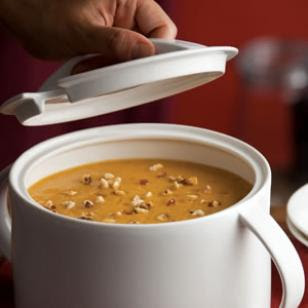
We served it with toasted cheddar and arugula sandwiches on Scholar's Inn wheat. We used walnuts, because that's what we had, and added a splash of brandy. SO GOOD! Next fall comfort food: my famous (or should I say infamous?) veggie chili!
What do you love to make in the fall? I'm feeling adventurous, it's time for new fall recipe ideas!
Tuesday, September 21, 2010
Just Eating

We decided to stick pretty closely to their 7 day eating plan. We generally eat pretty well, but it never hurts to have some expert help.
Can I just say . . . eating well is expensive!
As a kid, everything we had was hard-earned. I learned the value of penny-pinching by necessity, not choice. We shopped smart and ate smart. We gardened all summer and canned in the fall. We did pretty well, considering, but I know that my mom would have rather had some wiggle room for more food opportunity--trading the tuna mac for more vegetables, for example. (My mom, to this day, does not enjoy tuna mac.)
As an adult, I feel strangely settled into the middle class. Penny pinching is a wise choice, but it is a choice. We pinch when we can, and we've found value in paying more for just food. We usually get our produce from Green BEAN Delivery, meaning our local and organic produce is priced a touch lower than at the grocery, and it's conveniently delivered to our door. While it costs more than conventional produce, we feel it is worth it to buy food that is better for the environment, better for the people who grow and handle it, has less distance to travel, supports local agro-business, and ultimately tastes better and is better for us.
Since we were gone for 10 days, the cupboards were bare and we had to hit the grocery store. We spent 50% more than we normally do. Granted, we were stocking up, but it was painful. My childhood taught me many ways I could have saved $$ at the grocery. Organic soymilk is twice as expensive as conventional cow's milk. Organic spinach is over 4 times as expensive as conventional iceburg lettuce. Conventional eggs are half the price of eggs from cage-free, vegetarian fed hens. You get the picture.
I don't fault consumers for pinching pennies, especially in these economic times. Our food system has made cheap, abundant food mainstream--and even so, people are struggling. But food producers and suppliers (and I'm talking about top levels here) have been cashing in at our expense. Aside from issues of sustainability, how did it come to be that overprocessed, lower-nutrient foods are the norm? Why is it cheaper to eat yellow cake from a box than to eat a spinach salad? Why should it be a luxury to eat well?
Ben and I struggle with this as we weigh the cost of conventional vs. local, organic dairy. It hurts to pay more, and sometimes we go for cheap. But we can afford to shop our values, so we strive to. And basic economics tells us that increasing demand for quality food can lead to lower production costs, right?
I could write about food for days, and many people have done so much better than I could. Check out Food Inc or In Defense of Food, for starters.